Network Flow Discovery
Network Flow Discovery automatically builds a graph of service-to-service, service-to-database, and service-to-external flows by reading Kubernetes NetworkPolicies and GKE FQDNNetworkPolicies.
How it works
- A NetworkFlowDiscovery Custom Resource is created, linked to a Portal via
spec.portalRef(auto-created at startup for the main portal) - The controller periodically reconciles (every 60s) and:
- Lists all
NetworkPolicyresources (ingress rules → service-to-service flows) - Lists all
FQDNNetworkPolicyresources (egress rules → service-to-database/external flows) - Builds a graph of nodes and edges
- Stores nodes in a FlowNodeSet CR and edges in a FlowEdgeSet CR (both owned by the parent)
- Lists all
- The web UI and MCP server read from FlowNodeSet/FlowEdgeSet — no cluster queries at request time
CRDs
NetworkFlowDiscovery
The parent resource that drives reconciliation.
apiVersion: sreportal.io/v1alpha1
kind: NetworkFlowDiscovery
metadata:
  name: netflow-main
  namespace: sreportal-system
spec:
  portalRef: main
  # Optional: restrict to specific namespaces (default: all)
  namespaces: []
Status fields:
| Field | Description |
|---|---|
status.nodeCount | Number of discovered nodes |
status.edgeCount | Number of discovered edges |
status.lastReconcileTime | When the graph was last rebuilt |
status.conditions | Ready condition indicating reconciliation success |
FlowNodeSet
Stores all discovered nodes. Auto-created and owned by the parent NetworkFlowDiscovery.
- Named
<parent>-nodes(e.g.netflow-main-nodes) spec.discoveryRefreferences the parentstatus.nodes[]contains the discovered nodes
Each node has the following fields:
| Field | Description | Example |
|---|---|---|
id | Unique identifier | service:namespace-a:service-1 |
label | Human-readable name | service-1 |
namespace | Kubernetes namespace | namespace-a |
nodeType | Classification (see below) | service |
group | Logical group (namespace) | namespace-a |
FlowEdgeSet
Stores all discovered edges. Auto-created and owned by the parent NetworkFlowDiscovery.
- Named
<parent>-edges(e.g.netflow-main-edges) spec.discoveryRefreferences the parentstatus.edges[]contains the discovered edges
Each edge has the following fields:
| Field | Description | Example |
|---|---|---|
from | Source node id | service:namespace-a:service-1 |
to | Target node id | service:namespace-b:service-2 |
edgeType | Flow type (see below) | cross-ns |
Deleting the parent NetworkFlowDiscovery automatically garbage-collects both children.
Node types
Nodes are classified by port:
| Type | Rule |
|---|---|
service | Pods referenced in NetworkPolicy ingress rules (app.kubernetes.io/name label) |
cron | CronJobs referenced in NetworkPolicy ingress rules (basename label) |
database | FQDNs on ports 5432, 1433, 3306 |
messaging | FQDNs on ports 5672, 5671 |
external | All other FQDNs in egress rules |
Edge types
| Type | Meaning |
|---|---|
internal | Flow between services in the same namespace |
cross-ns | Flow between services in different namespaces |
cron | Flow from a cron job to a service |
database | Flow from a service to a database |
messaging | Flow from a service to a messaging broker |
external | Flow from a service to an external endpoint |
Web UI
The Network Policies page (/:portalName/netpol) is organized into three tabs:
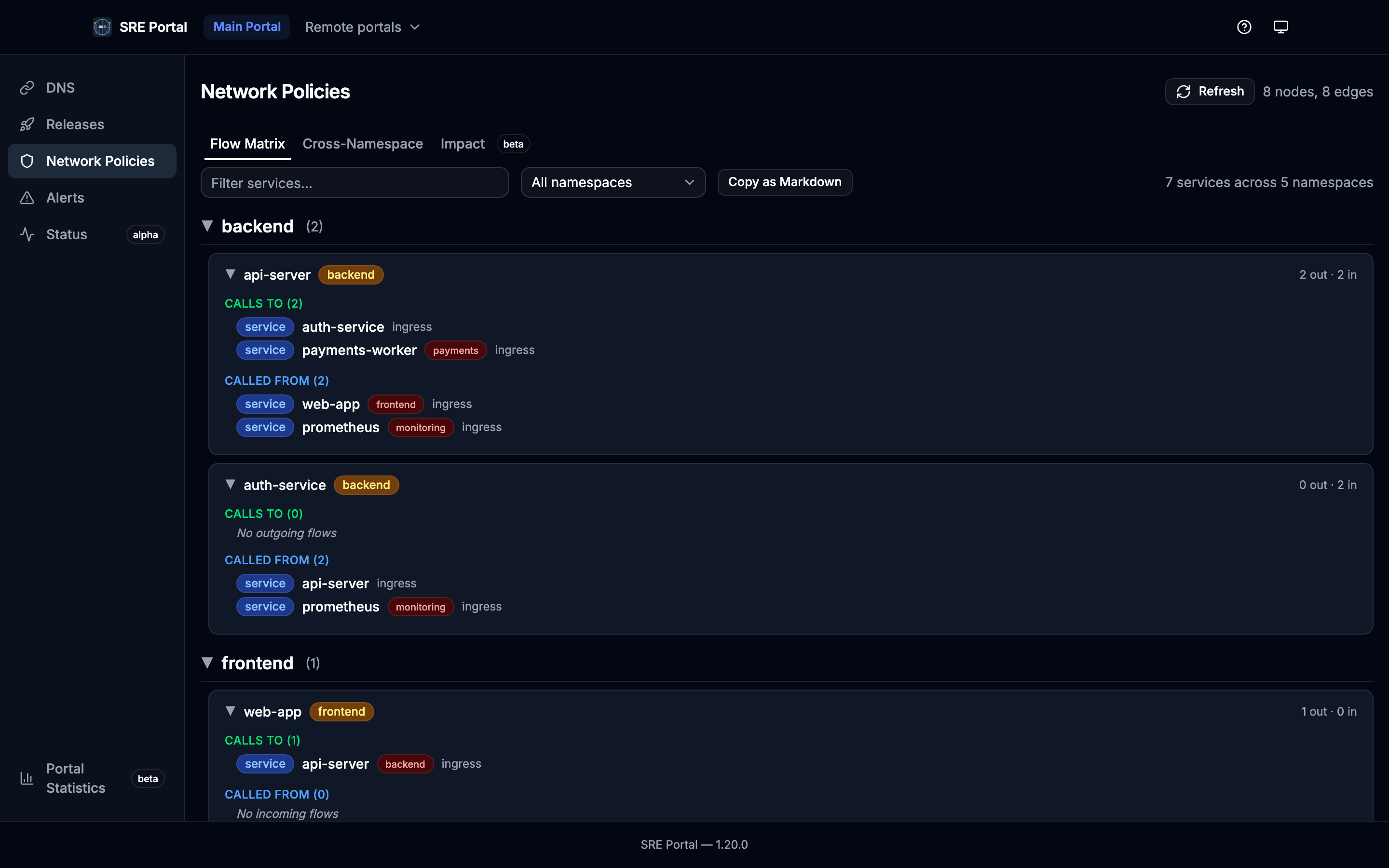
Flow Matrix
Lists every service with its outgoing and incoming flows. Features:
- Collapsible namespace and service sections
- Search filter and namespace dropdown
- Copy as Markdown for documentation/audit export
Cross-Namespace
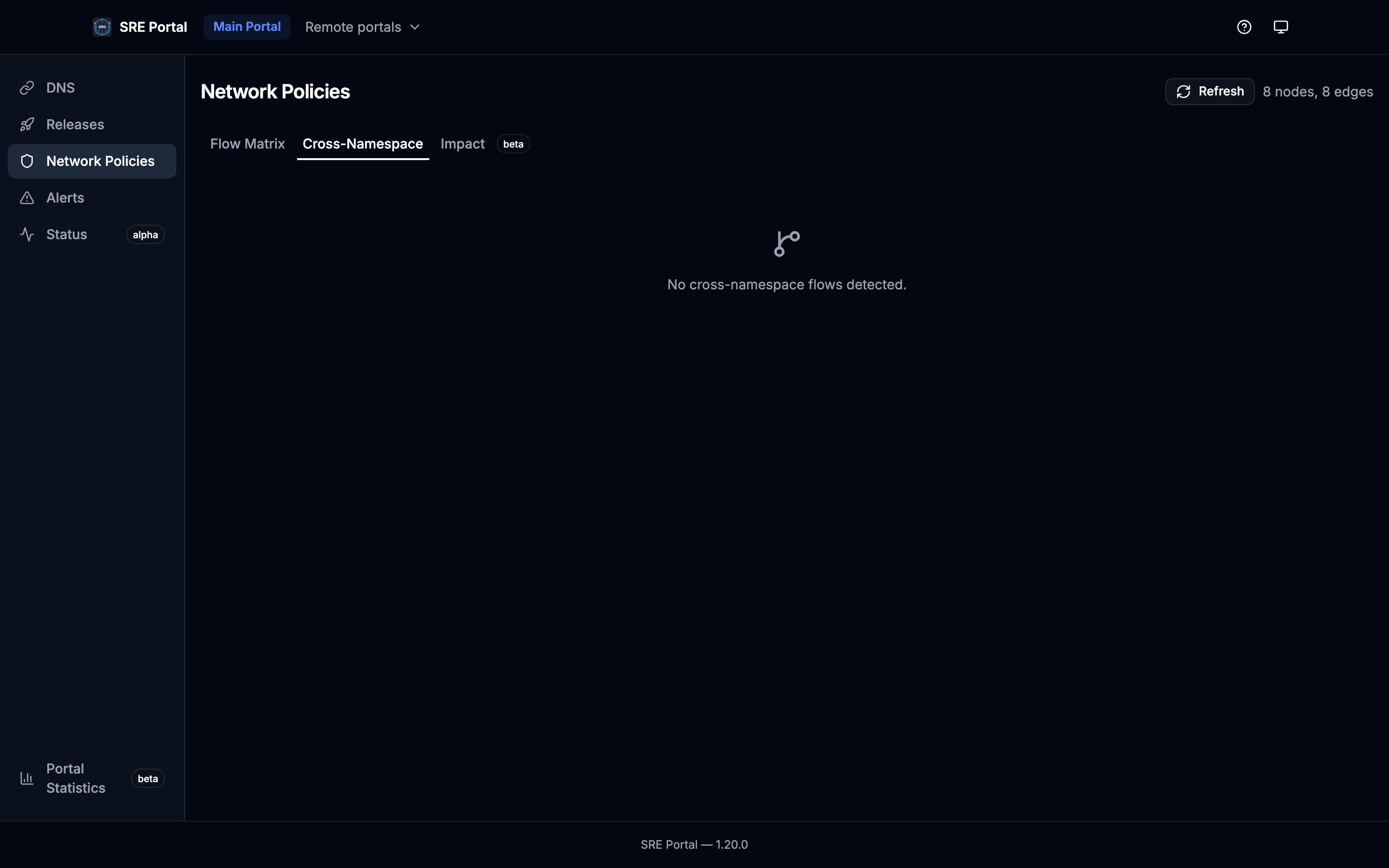
Aggregated matrix showing flow counts between namespaces. Useful for understanding inter-team dependencies.
Flow Explorer
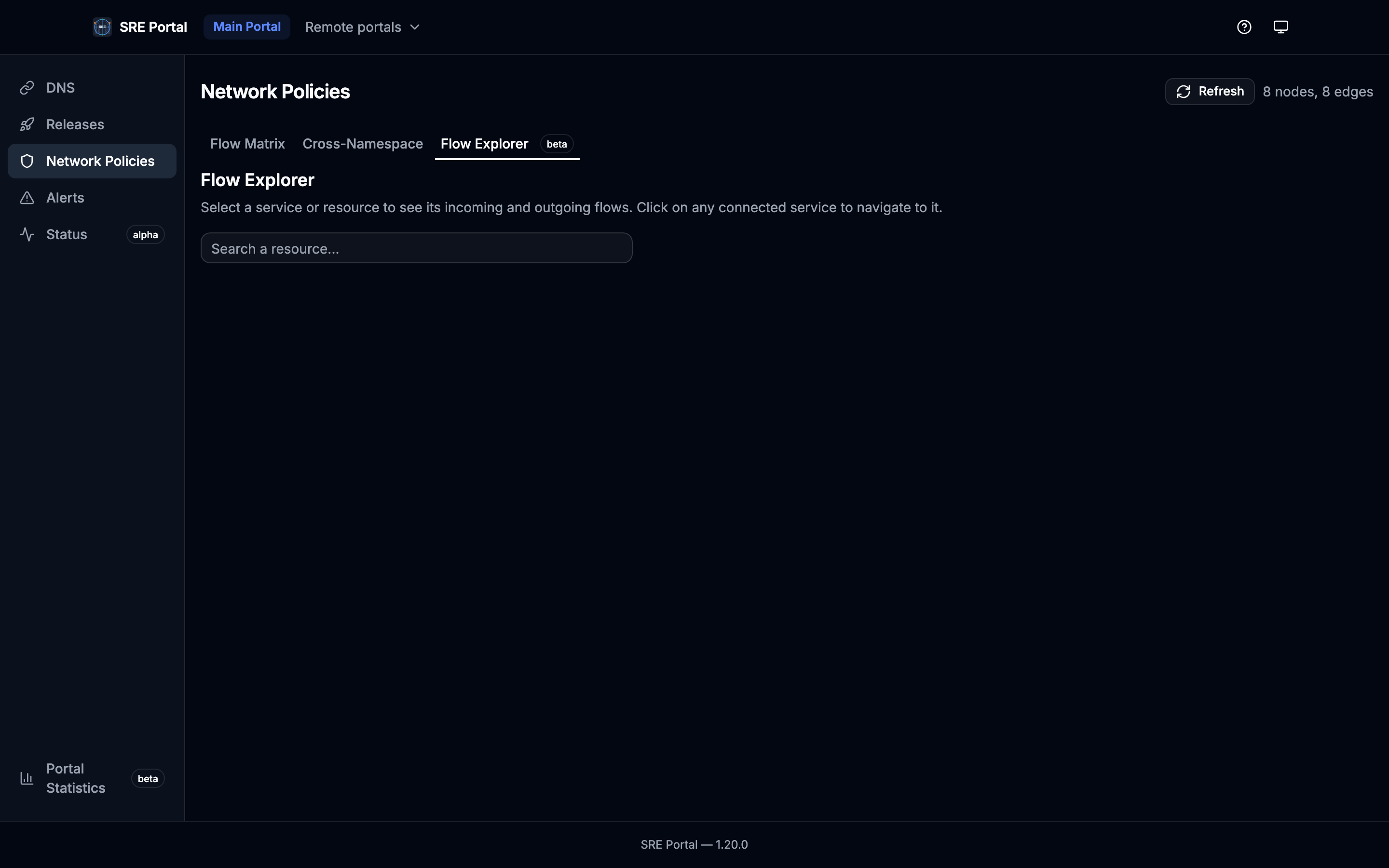
Select any resource (database, service, external endpoint) to see its direct incoming and outgoing flows in a butterfly layout:
- Left column: services that call the selected resource (incoming), grouped by namespace in collapsible sections
- Center: the selected resource with incoming/outgoing counts
- Right column: services/resources that the selected resource calls (outgoing), grouped by namespace in collapsible sections
Click on any connected service to navigate to it and explore its own flows — this allows depth-first exploration without needing a multi-level BFS view.
MCP Server
Available at /mcp/netpol with two tools:
| Tool | Description | Parameters |
|---|---|---|
list_network_flows | List all nodes and edges in the flow graph | search |
get_service_flows | Get incoming/outgoing flows for a specific service | service (required) |
Kubernetes API calls
The controller makes exactly two LIST calls per reconciliation cycle (every 60s):
GET /apis/networking.k8s.io/v1/networkpoliciesGET /apis/networking.gke.io/v1alpha3/fqdnnetworkpolicies(silently skipped if CRD is absent)
The web UI and MCP server read only from FlowNodeSet/FlowEdgeSet CRDs — zero cluster queries at request time.